
- Index
- Certification
- Composition
- .999 Silver (10)
- .9999 Silver (28)
- 99.99% Pure Silver (29)
- Aluminum (18)
- Bi-metallic (6)
- Billon (11)
- Bronze (56)
- Copper (12)
- Copper-nickel (5)
- Gold (37)
- Gold And Silver (9)
- Gold, Silver (9)
- Nickel (10)
- Pure Silver (14)
- Silver (3888)
- Silver 925 / 1000 (13)
- Silver 999 / 1000 (10)
- Silver Certificate (7)
- Silver With Opal (5)
- Varies (6)
- ... (2119)
- Denomination
- Fineness
- Grade
- Year
RARE (100pcs) AWARDED Chad ILLUSION ROOM V2 Silver Coin 200 Francs 2023 OPTICAL
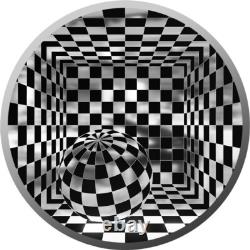
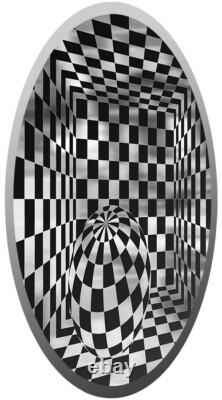

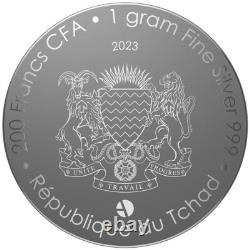

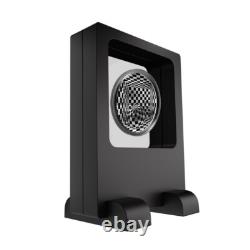


AWARDED COIN - UNIQUE CONCEPT NOMINATION WORLD Thinnest & Biggest 1 Gram Silver Coin (30mm diameter) V2 - Not-Gold Plated Version. (also V1 available in our store). Awarded Coin by XVIII Coin Constellation famous world competition. 100 produced only - confirmed by Artisan Coin Productions (despite the fact that the mintage is 999). IN STOCK - Official distributor!
Republic of Chad ILLUSION ROOM series WORLD Thinnest & Biggest 1 Gram Silver Coin 200 Francs 2023 (keyword: Optical Illusion) Official Legal Tender Collectible Silver Coin Note: on the 3D promo-video - the coin's rim is wider on a real coin (like on the pictures). This video demonstrates a general view and the coin's aesthetics. 30 mm / 1.9 inch.
0.15 mm / 0.006 inch (World thinnest silver round coin). Optical Illusion effect; Top Quality Printing (not digital-printing). Yes - watch in Pictures section. RARE - 100 produced only.«Our separation from each other is an optical illusion» Albert Einstein. From COTY (Coin of the World) multi-winner designer - Artisan Coin Productions ___.
AWARDED COIN - UNIQUE CONCEPT NOMINATION The results of the XVIII Coin Constellation summed from 20 countries of the world presented a few hundred modern coins in 2023. The future of numismatics is here, in many details such as calls latent images, which are used as security features until today. These images work because two, three, or even four depictions were painted on different sides of the flan, which are arranged in such a way that the viewer sees a different image depending on his angle of view and depending on also how we move the coin in the light. Thanks to the optical illusion we can see curved lines where there are straight lines, moving circles from a still image, or dark dots at the intersection of black squares. Pure magic on a 30mm diameter coin.
Unique combination of Black paint with Proof finish to achieve a minimalistic 3D dimension effect! V2 - Not-Gold Plated Version.
World Thinnest & Biggest 1 Gram Silver Coins - thickness is only 0.15 mm / 0.006 inch and a large diameter of 30 mm / 1.9 inch. Top Quality Printing (Not digital-printing).
Within visual perception, an optical illusion (also called a visual illusion) is an illusion caused by the visual system and characterized by a visual percept that arguably appears to differ from reality. Illusions come in a wide variety; their categorization is difficult because the underlying cause is often not clear but a classification proposed by Richard Gregory is useful as an orientation.According to that, there are three main classes: physical, physiological, and cognitive illusions, and in each class there are four kinds: Ambiguities, distortions, paradoxes, and fictions. A classical example for a physical distortion would be the apparent bending of a stick half immerged in water; an example for a physiological paradox is the motion aftereffect (where, despite movement, position remains unchanged). We do not accept cancellations once your order is placed.