
- Index
- Composition
- .999 Silver (10)
- .9999 Silver (28)
- 99.99% Pure Silver (29)
- Aluminum (18)
- Bi-metallic (6)
- Billon (11)
- Bronze (56)
- Copper (12)
- Gold (37)
- Gold And Silver (9)
- Gold, Silver (9)
- Nickel (10)
- Pure Silver (14)
- Silver (3905)
- Silver 925 / 1000 (13)
- Silver 999 / 1000 (10)
- Silver And Gold (5)
- Silver Certificate (7)
- Silver With Opal (5)
- Varies (6)
- ... (2122)
- Denomination
- Fineness
- Grade
- Km Number
- Year
RARE 100pc LUNAR RABBIT Calendar V1 Silver Coin 2023 Chad OPTICAL ILLUSION Gl.pl
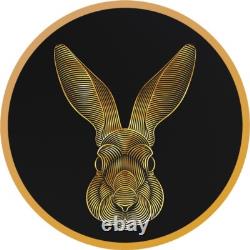
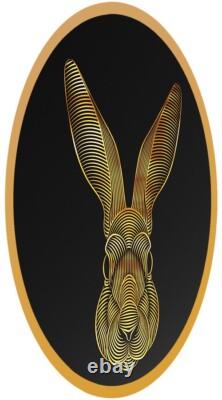
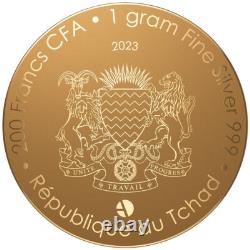

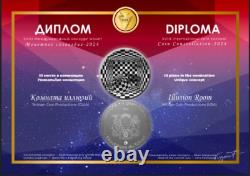
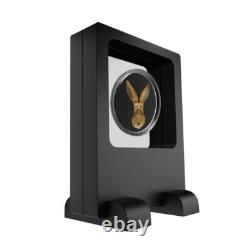

AWARDED COIN SERIES - in UNIQUE CONCEPT NOMINATION WORLD Thinnest & Biggest 1 Gram Silver Coin (30mm diameter) V1 - Gold Plated Version (also V2 available in our store) The Illusion Room coin (from the series) received an UNIQUE CONCEPT COIN Award by XVIII Coin Constellation famous world competition. 100 produced only - confirmed by Artisan Coin Productions. (despite the fact that the mintage is 999). IN STOCK - Official distributor! Republic of Chad LUNAR RABBIT CHINESE CALENDAR series WORLD Thinnest & Biggest 1 Gram Silver Coin 200 Francs 2023. (keywords: Optical Illusion, Zodiac, Lunar Year, Asia, China, India). Official Legal Tender Collectible Silver Coin. 30 mm / 1.9 inch.
0.15 mm / 0.006 inch. Optical Illusion effect; Gold plated; Top Quality Printing (not digital-printing).
Yes - watch in Pictures section. RARE - 100 produced only. «The eternal silence of these infinite spaces frightens me» Blaise Pascal. From COTY (Coin of the World) multi-winner designer - Artisan Coin Productions ___.
The Illusion Room coin (from the series) received an UNIQUE CONCEPT COIN Award by XVIII Coin Constellation famous world competition - summed from 20 countries. The most advanced technology at the service of numismatics. The last software, laser and 3D technology that allow us to work with the finest blanks ever seen. To find a similar type of blank, one would have to go back to the Middle Ages and its very thin silver (significantly smaller) but they had the drawback of, and for this very reason, not being able to make complex iconographic motifs. Laser technology opens up completely new possibilities in terms of design, because we can add an unlimited number of other textures with interesting visual effects.
The Rabbit, symbol of longevity, peace and prosperity in Chinese culture will possibly open the door to a new era in the ancient science of numismatics. Unique combination of Black paint with Proof finish to achieve a minimalistic 3D dimension effect! World Thinnest & Biggest 1 Gram Silver Coins - thickness is only 0.15 mm / 0.006 inch and a large diameter of 30 mm / 1.9 inch.
Top Quality Printing (Not digital-printing). The rabbit is the fourth in the twelve-year periodic sequence (cycle) of animals that appear in the Chinese zodiac related to the Chinese calendar. The Year of the Rabbit is associated with the Earthly Branch symbol. V1 - Gold Plated Version. (also V2 available in our store).
Within visual perception, an optical illusion (also called a visual illusion) is an illusion caused by the visual system and characterized by a visual percept that arguably appears to differ from reality. Illusions come in a wide variety; their categorization is difficult because the underlying cause is often not clear but a classification proposed by Richard Gregory is useful as an orientation. According to that, there are three main classes: physical, physiological, and cognitive illusions, and in each class there are four kinds: Ambiguities, distortions, paradoxes, and fictions. A classical example for a physical distortion would be the apparent bending of a stick half immerged in water; an example for a physiological paradox is the motion aftereffect (where, despite movement, position remains unchanged). We do not accept cancellations once your order is placed.